Best Language Learning Apps in 2026: What Each One Actually Teaches
An honest guide to LangLearn, Duolingo, Babbel, Pimsleur, Anki, italki, AI chatbots and more: which skill each app trains, what it misses, and how to combine them.

Ask ten people which language app is best and you will get ten answers, usually followed by the length of their streak. The honest answer is that no single app teaches a whole language. Each one is very good at one or two skills and weak at the rest. Once you know which is which, choosing gets easy.
The short answer
There is no best app for everyone, only the best combination for you. Use one tool for daily listening, one for vocabulary or structure, and add real conversation (a tutor, an exchange partner or an AI chatbot) once you can follow simple speech. Free tools are enough to start; pay only to fill the gap you actually have.
A note before we start: we make LangLearn, one of the apps below. We have tried to describe every tool, ours included, by what it is genuinely good and bad at. Prices and features change often, so check each app's own website before you pay.
First: what does a language app actually teach?
Learning a language means building several skills at once: understanding speech, speaking, vocabulary, grammar, and reading and writing. They grow at different speeds, and no app trains them all equally. A game-like app can make you great at matching words on a screen and still leave you lost in a real conversation.
Listening deserves special attention at the start. In one study, listeners understood a passage adequately when they knew about 95% of its words (van Zeeland and Schmitt, 2013), and researcher Paul Nation estimated that around 6,000 to 7,000 word families cover 98% of everyday spoken English. That is why audio pitched at your level is worth far more than audio that is simply authentic.
The apps at a glance
| App | Best for | How you pay |
|---|---|---|
| Duolingo | A fun daily habit and first steps | Free, with an optional subscription |
| Babbel | Structured lessons with clear grammar | Subscription |
| Pimsleur | Speaking and pronunciation, audio only | Subscription |
| LangLearn | Listening at your level, with your learning speed measured in words per hour | Free for now; optional paid plan for better audio |
| Anki | Remembering vocabulary long term | Free on computers, Android and the web; one-time purchase on iPhone |
| LingQ | Reading and listening to real content | Limited free version, then subscription |
| italki | One-to-one lessons with a tutor | Pay per lesson; each tutor sets the price |
| HelloTalk, Tandem | Chatting with native speakers | Limited free version, then subscription |
| ChatGPT, Claude | Conversation practice and explanations on demand | Limited free version, then subscription |
The apps, one by one
Duolingo
Duolingo turns learning into a game, with short lessons, streaks and leagues that make it easy to open the app every day. It is a friendly first step, especially if you have never studied a language before. In a peer-reviewed study, learners who finished its beginner Spanish or French course scored about as well in reading and listening as university students after four semesters (Jiang and colleagues, 2021). The authors worked for Duolingo, and speaking was not tested.
Watch out: the game can reward keeping your streak more than learning, and most exercises are short sentences, not real conversation.
Babbel
Babbel feels closer to a classic course: lessons of roughly 10 to 15 minutes built around everyday dialogues, with grammar explained along the way. It suits people who like to understand why a sentence works, not just memorise it.
Watch out: you still need plenty of listening and real speaking outside the app, and it offers fewer languages than Duolingo.
Pimsleur
Pimsleur is audio only. In lessons of about 30 minutes, a speaker prompts you, you answer out loud, and phrases come back at growing intervals so they stick. It is one of the best ways to start speaking with decent pronunciation, and it works in the car.
Watch out: it teaches a fairly small number of words per hour and almost no reading.
LangLearn
LangLearn is our app, and it is built around how people actually pick up a language: by listening to speech they can follow. Words are ranked by how often they are used, and every lesson and story uses only the words you already know plus a few new ones, each explained in your own language. When you hear a new word in a story, tap the sentence and mark the word Unknown. The new stories your AI writes for you then bring that word back again and again, and once you have heard it 20 times at normal speed, LangLearn moves it to Known. Lessons also practise conversation: a role-play sets the scene, pauses so you can answer out loud, then gives the answer.
Watch out: you can read every story and conversation while you listen, but writing gets less practice, and a human tutor still gives the best feedback on your speaking. The iPhone app is not out yet; LangLearn runs in the browser, and the Android app is in early access.
Anki
Anki is a flashcard program that shows each card just before you are likely to forget it, a method called spaced repetition. For pure memorisation of words, it is hard to beat, and it is free everywhere except iPhone.
Watch out: it looks plain, you have to make or download your own cards, and cards alone will not teach you to understand fast speech.
LingQ
LingQ lets you read and listen to real material, such as articles, podcasts and books, and tap unknown words as you go. It shines once you know a few thousand words and want to move on to content made for native speakers.
Watch out: for a complete beginner, most real content is still far too hard to enjoy.
italki
italki is a marketplace of tutors who teach one-to-one over video. Nothing beats a patient person for speaking practice and honest feedback on your mistakes, and you choose the tutor, the time and the length of each lesson.
Watch out: you pay for every lesson, and an hour of talking does not replace the many hours of listening you also need.
HelloTalk and Tandem
These apps connect you with native speakers who want to learn your language: you help them, they help you, mostly through text and voice messages. They are a cheap way to use the language with real people.
Watch out: the quality depends entirely on your partner, and it works best once you can already put simple sentences together.
ChatGPT, Claude and other AI assistants
AI assistants can hold a conversation in almost any language, explain grammar, correct your sentences and write stories at your level on any topic you like. They are endlessly patient and available at three in the morning.
Watch out: they sometimes make mistakes with total confidence, and they only teach what you ask for, so you need a plan of your own.
Streaks measure effort. LangLearn measures learning.
Most apps report streaks, points or minutes. Those tell you how much you used the app, not how much of the language you gained. LangLearn shows a different number on every learner's dashboard: words learned per hour of listening. It counts only words you learned in the app, not words you already knew, and divides them by every minute you listened, repeats and slow playback included.
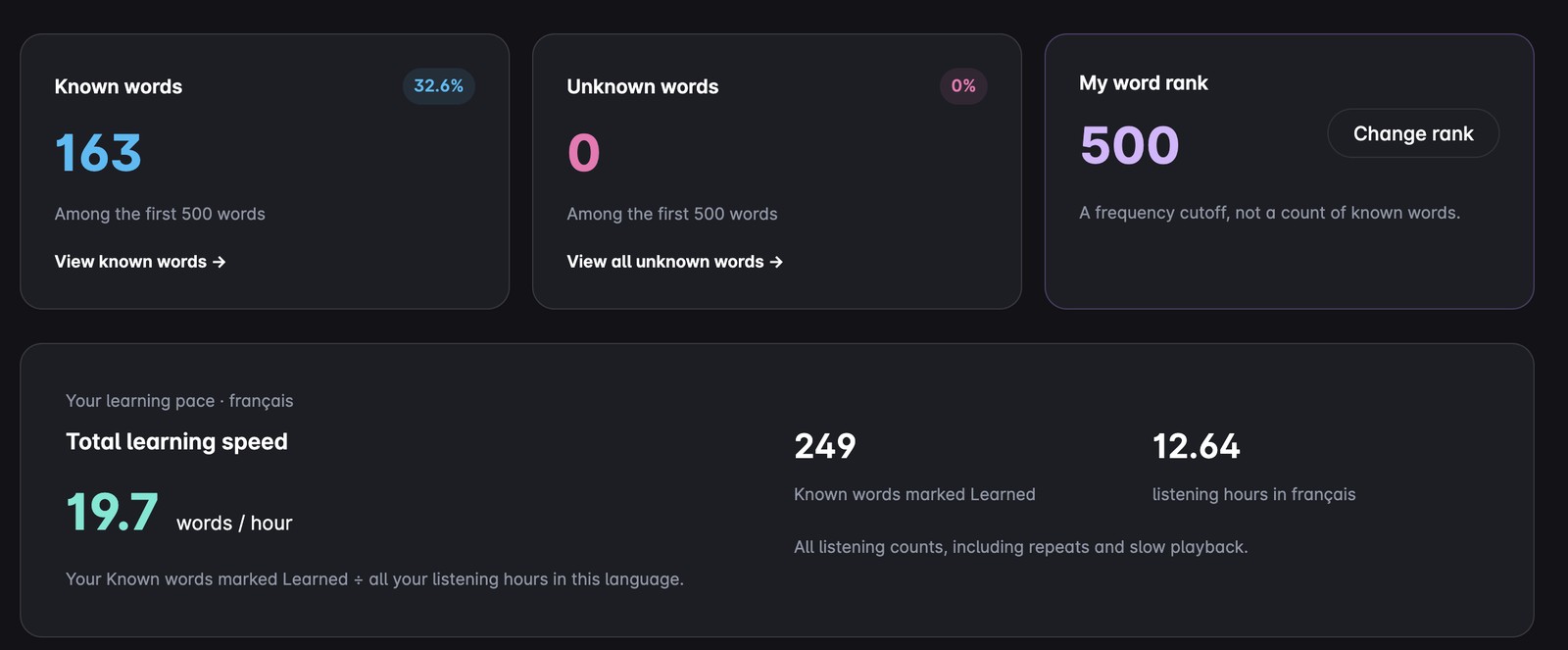
Because the speed is measured, you can see what works. If a new routine or playlist raises your words per hour, keep it; if the number drops, change something. The dashboard also shows where you stand among the most common words of the language: which ones you know, which you have marked Unknown and are still hearing, and which you have not met yet.
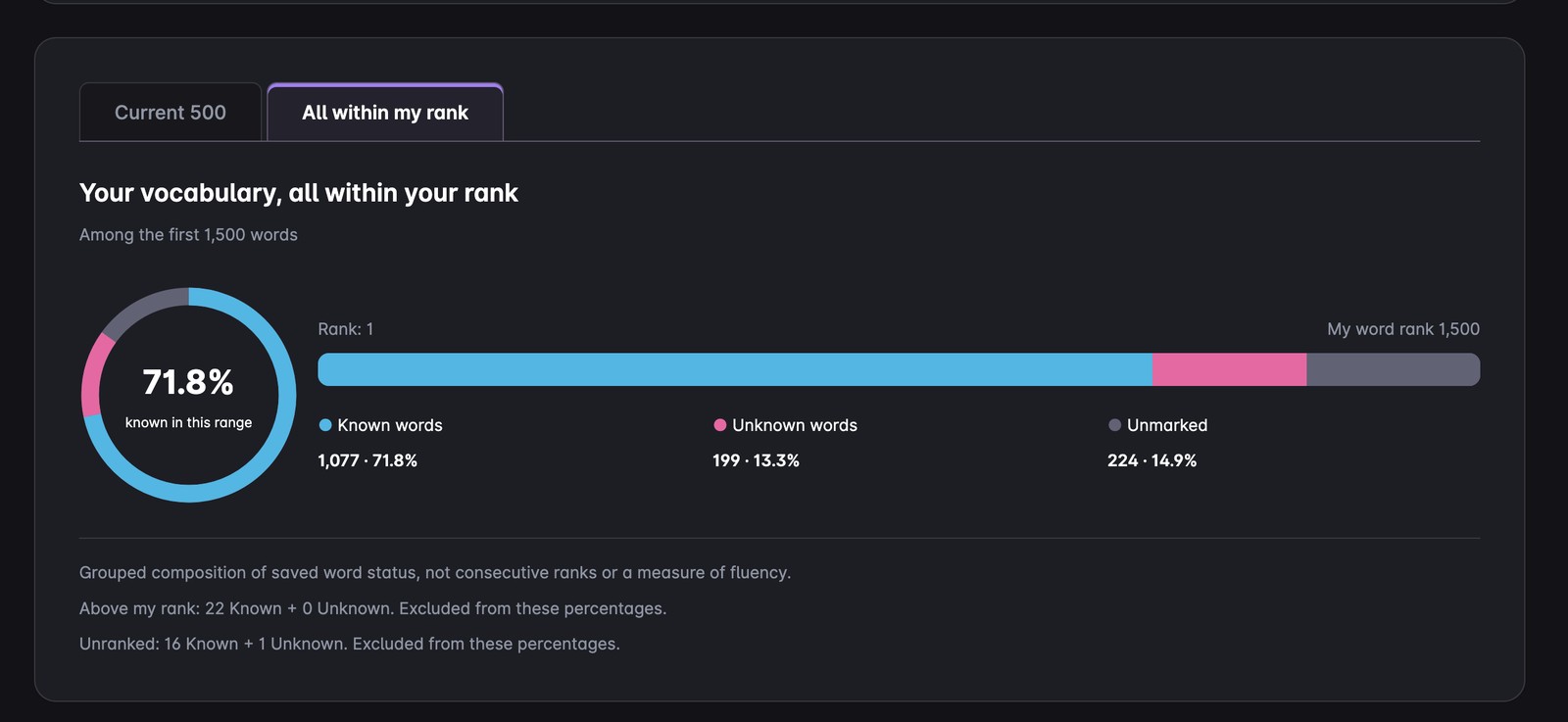
The aim is not more new words for their own sake. It is spending less time to understand real speech and hold a conversation, because the common words you need are the ones you have actually heard again and again.
Pick your combination
Here are combinations that work for common situations. Each one covers listening, vocabulary and speaking without paying twice for the same skill.
Zero budget
LangLearn for daily listening, Anki for vocabulary, and a free AI chatbot or a language exchange for conversation once simple sentences come easily.
Twenty minutes on the commute
Audio that needs no screen: LangLearn stories or a Pimsleur lesson on the way, plus a few minutes of flashcards while you wait.
A trip in three months
Pimsleur or Babbel for survival phrases, daily listening, and three or four tutor lessons before you go to practise ordering food, asking the way and small talk.
Serious about fluency
Daily listening at your level, then real content in LingQ as your vocabulary grows, and a weekly tutor or exchange partner to keep your speaking in step.

Is your app actually working? A one-month test
Streaks and points measure effort, not progress. Once a month, try this instead:
- Replay something old. Listen again to audio that was hard a month ago. Do you understand more of it now?
- Talk for one minute. Describe your day out loud in the language. Is it easier than last month?
- Look at your new words. Are they words you actually hear, or rare words you will almost never meet?
- Count real minutes. How much of your app time was spent hearing or using the language, rather than tapping through menus?
If two or more answers are no, change what you use, not just how hard you try.
Where LangLearn fits
LangLearn fills the listening slot in any of these combinations. Pick your first language and the one you want to learn, start at your level and press play. Words come in order of how common they are, so 500 of them already cover about half of what you hear.
It runs in your browser, works hands-free on a walk or a commute, and is free to start. Connect Claude or ChatGPT and your AI can write new stories at your exact level, which LangLearn checks word by word and reads aloud.
Frequently asked questions
Can you become fluent with Duolingo alone?
It is unlikely. Duolingo is good for building a habit and learning the basics, but fluency needs many hours of listening to real speech and regular speaking practice, which no single app provides. Use it as one part of your routine.
What is the best free language learning app?
No single free app covers everything, so combine them: Duolingo or LangLearn for daily practice, Anki for vocabulary, and a free AI chatbot or a language exchange for conversation. Together they cover more than most single paid apps.
Which app is best for speaking?
A human tutor, for example on italki, gives the best feedback. Among self-study apps, Pimsleur makes you answer out loud in every lesson, LangLearn's lessons include role-plays you answer out loud, and AI chatbots let you practise conversation whenever you like.
Which app is best for listening?
The best listening app is the one whose audio you can mostly understand. LangLearn builds stories only from the words you already know; once you know a few thousand words, podcasts and the real content in LingQ are the next step.
Can ChatGPT or Claude replace a language app?
They are excellent for conversation, explanations and practice texts, but they do not plan your learning or remember which words you know, and they sometimes make mistakes. They work best alongside an app or a course.
How many minutes a day should I use a language app?
Twenty to thirty minutes a day is a realistic target for most adults. Consistency matters more than length: a short session every day beats a long one once a week.
Are paid language apps worth it?
Only when they fill a gap you actually have. Free tools cover a lot, so pay for something specific, such as a tutor for speaking or a structured course you will really use.
Which app shows how fast you are actually learning?
Most apps show streaks, points or minutes spent. LangLearn shows words learned per hour of listening, plus how many of the language's most common words you know, so you can see whether your routine is working.
Sources
- Jiang, X., Rollinson, J., Plonsky, L., Gustafson, E. & Pajak, B. (2021). Evaluating the reading and listening outcomes of beginning-level Duolingo courses. Foreign Language Annals, 54(4).
- van Zeeland, H. & Schmitt, N. (2013). Lexical coverage in L1 and L2 listening comprehension: The same or different from reading comprehension? Applied Linguistics, 34(4).
- Nation, I. S. P. (2006). How large a vocabulary is needed for reading and listening? Canadian Modern Language Review, 63(1).
- Anki manual (ankiweb.net)
